





About
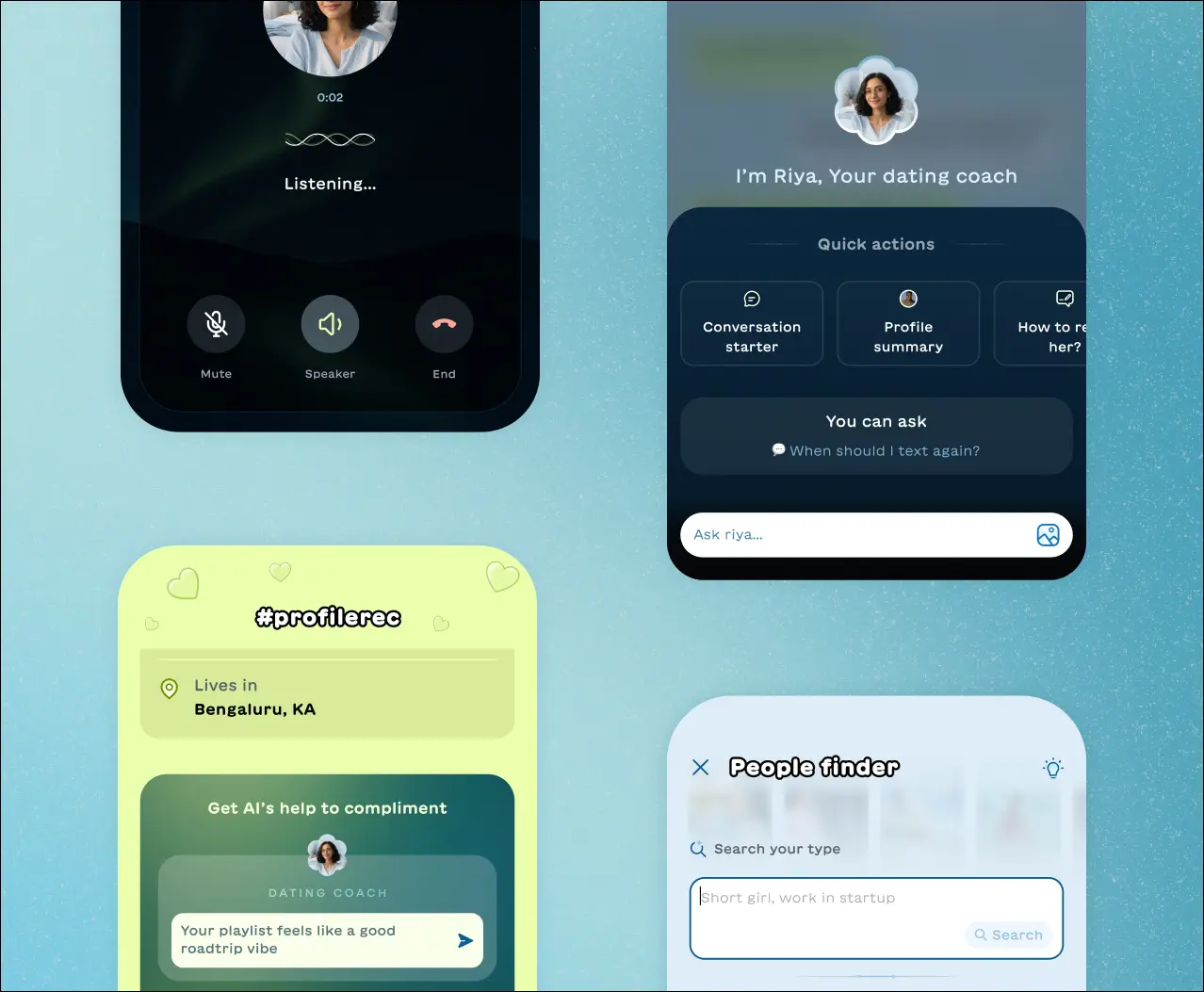
Schmooze is a dating app that matches you on personality, not just looks. You swipe on memes, use AI search, or talk to an AI matchmaker — the app figures out your vibe and finds people who match it.

Role:
Everything design
Strategy
Team:
Dewanshi
(Sr designer)
Timeline:
2023-26
Desc:
How we fixed the onboarding, one friction point at a time
The challenge
The onboarding was leaking. Most users who dropped never made it to their first match, which meant they left before they ever saw the thing that made Schmooze worth using. We were judged on a first impression that hadn't finished loading.
This case study is about closing that gap, one friction point at a time.
The leaky funnel
The problem. Our original onboarding was one long linear flow - personal details, match preferences, meme preferences, photos, all in a single scroll. We knew roughly 30% of users were dropping off, but the funnel was a black box. We couldn't see where the floor gave way.
What we did. We broke onboarding into three distinct chapters - basic details, meme preferences, match preferences - each with its own small arc. Between them we added moments of payoff: a little animation, a line of encouragement, a small celebration after the first photo upload. The goal was to make it feel less like filling out a tax form and more like the app was reacting to you.


What happened?
Drop-off fell by 12%. The interesting part is what that number contradicted: the new flow was longer than the old one, and it still performed better. The conventional wisdom - shorter onboarding always wins - turned out to be wrong for us. People didn't quit because there were too many steps. They quit because the steps were boring.

We tried a stripped-down onboarding to get users in faster. It worked — until it didn't. Thin profiles meant worse matches, and they churned anyway, just later. We'd won the metric we were watching and lost the one that mattered.
The interruption
Even with the better flow, we kept losing a specific kind of users, the one who started signing up, got interrupted by a call or a notification or actual life, and came back later to find themselves dumped right back at step one. Nobody re-does a form they already half-finished. They just leave.

Protecting users from their own taps
The problem. Support tickets were piling up with the same request - please change my age / my gender / who I'm matched with. The culprit was boring: we were using the default OS confirmation dialogs. Tiny text, two grey buttons, the kind of thing every one of us has tapped "OK" on without reading. Users were locking in important choices on autopilot.
Worse, people were setting wildly broad age ranges - a 22-year-old looking for "20 to 40" - which quietly affecting match quality for people.
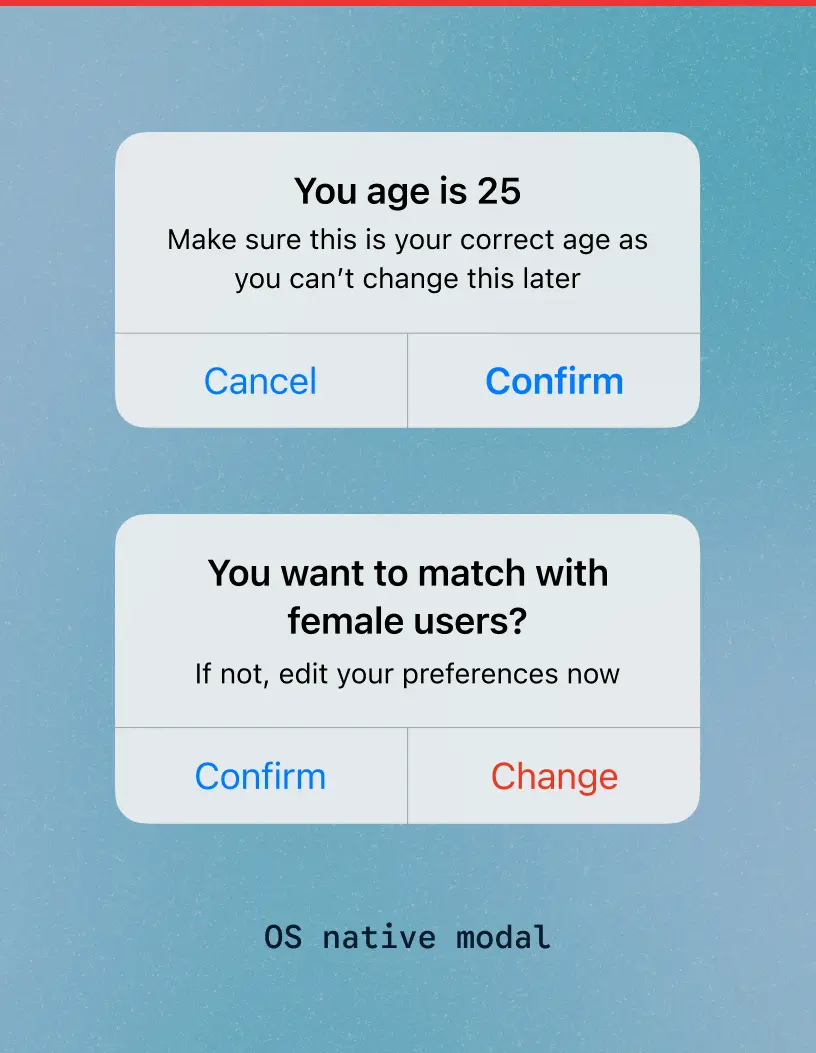

What we did. replaced the native dialogs with custom ones - clear layout, icons, plain-language copy, real touch targets. This alone significantly reduced customer support tickets from users asking to change their gender and age settings.
What happened. This alone significantly reduced customer support tickets from users asking to change their gender and age settings.
We treated the age range as a safety issue, not just a UX one. A 22-year-old searching for 20-40 wasn't just getting worse matches, they were potentially exposing younger users to mismatched intent. A tooltip nudged them toward a tighter range, suggested based on their own age. No hard block, just a quiet push in the right direction. Over-wide age ranges went from around ~35% down to around 15%.
The blank canvas
The bingelist (shows and movies) and playlist (music) sections feed the algorithm a sense of your taste. But we were handing users an empty field and a blinking cursor, which is the UX equivalent of a stranger asking "so, what kind of music are you into?" and watching every band you've ever heard of evaporate from your brain. People stalled here for 3–4 minutes, and plenty just skipped it.
How we fixed: One tap fills four slots with smart suggestions. Keep what fits, swap what doesn't. Time on screen dropped, and section completion went up 40%. Give people a starting point and they'll edit. Give them nothing and they'll leave.
What happened. Time on the screen dropped decently, and we saw a 40% lift in users actually completing the section.
Keeping the bad actors out

What happened. 60% of users who saw the photo guide went on to upload a proper face photo and continue. The flood of obviously fake profiles thinned out noticeably.
The underage problem. Every day, 7-10% of signups were underage, and half were faking an 18+ birthday — minors landing in an adult dating pool. Not a metric problem. A legal and moral one.
The age gate was the easy part. The hard part was the repeat offender: get flagged, delete the account, make a new one with a different birthday, try again.
What we built. A device-ID-based flagging system. Get flagged once, and any attempt to re-register from the same device gets caught, new account or not.
After the new architecture. Genuine underage influx dropped to near zero.