






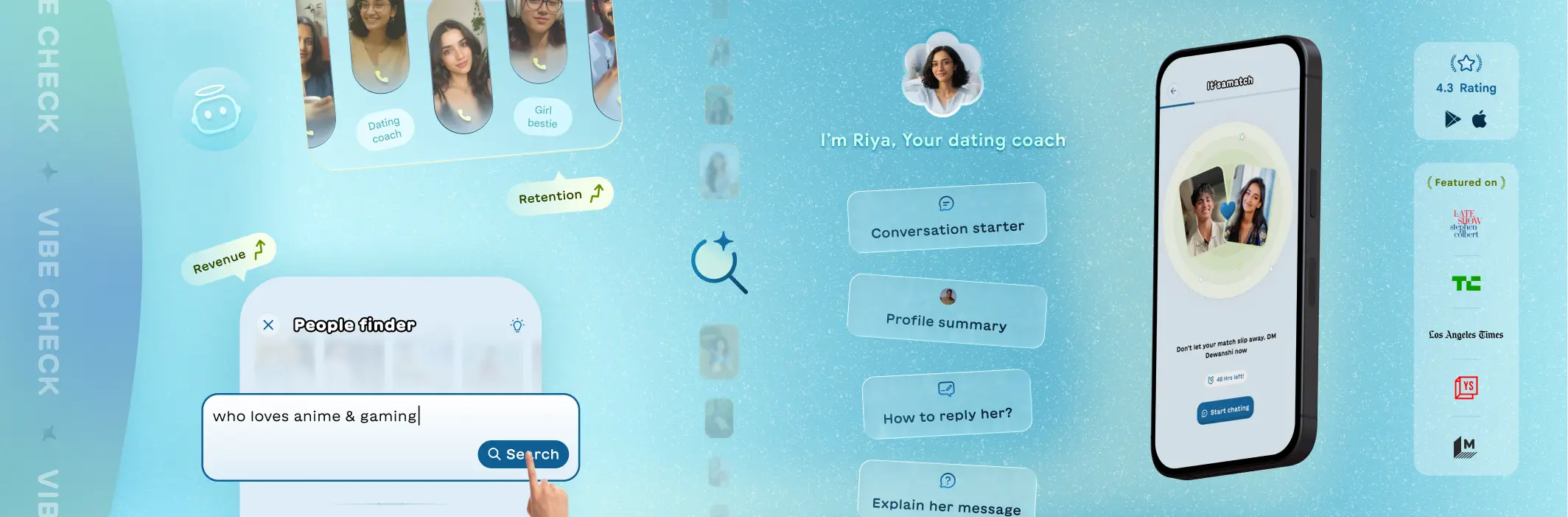
About
Schmooze is a dating app that matches you on personality, not just looks. You swipe on memes, use AI search, or talk to an AI matchmaker — the app figures out your vibe and finds people who match it.
Role:
Everything design
Strategy
Team:
Dewanshi
(Sr designer)
Timeline:
2023-26
Desc:
Retention, Conversation, Matching. How AI helped us tackle each one.
The challenge
Over about two years, we pushed more than half a dozen AI features into Schmooze. Some worked. One backfired entirely. One made real money almost by accident. One burned a frankly embarrassing amount in tokens and never paid off.
We didn't have an AI strategy. We had a series of bets, some from data, some from gut, one straight from customer support tickets. The pattern only made sense in hindsight.
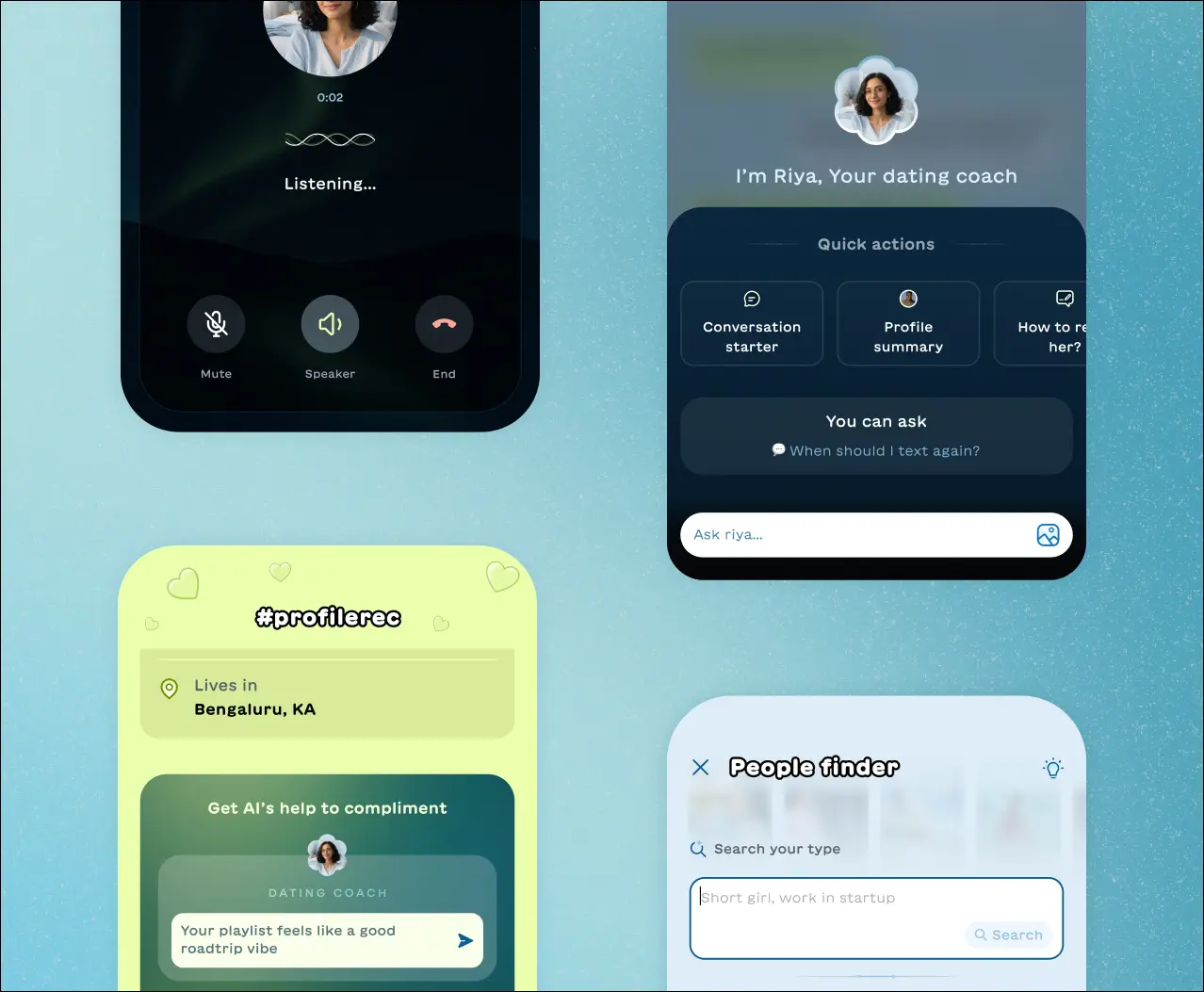
How it began - AI companion
The hypothesis. What if a user with zero matches still had someone to talk to? It was our first real swing at AI, and we genuinely had no idea which metric it would touch. We just knew that an empty dating app is a lonely place, and lonely places get deleted.
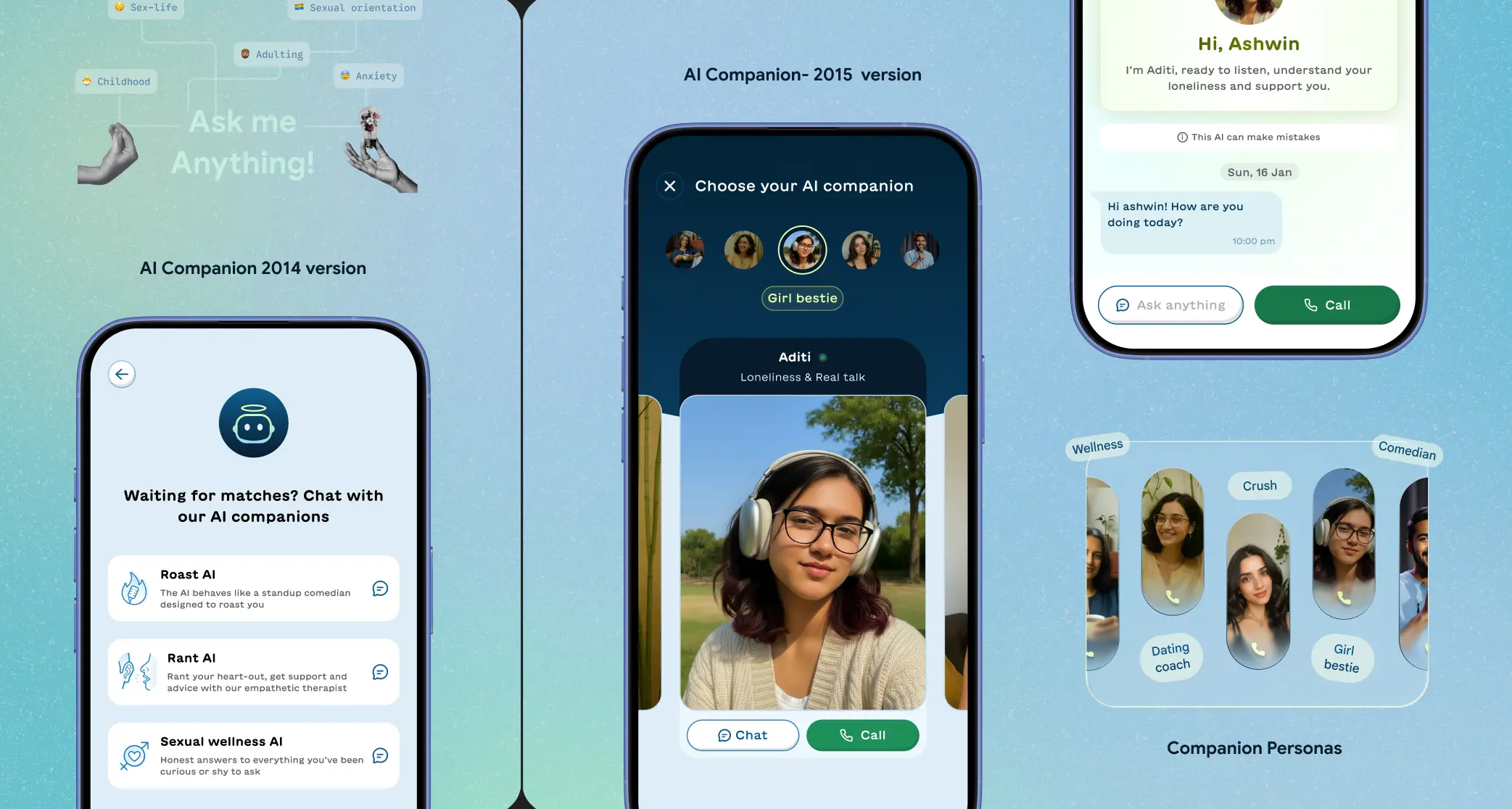
We gave the bots faces, names, personalities, and added voice calls. Engagement more than doubled. 16% of weekly active users were spending time with a feature that does nothing to help them find a match. Longest chat: 5,000 messages. Longest call: 82 minutes.
The call experiment. Voice calls were exciting until we tried to monetise them. Adoption dropped, willingness to pay was lower. And unlike text, voice runs three separate models in sequence: speech-to-text, the LLM, then text-to-speech back. The compute cost per conversation was significant. Free wasn't sustainable, paid didn't convert. We pulled the feature and moved on.
The lesson: We went looking for engagement and accidentally built a retention engine. Sometimes the product doesn't need what you set out to give it - it needs the thing you stumble into along the way. Keep your eyes open enough to notice.
The ice breaker - AI Dating Coach
The problem. Matched chatrooms kept going dark. A full 20% of them never got a real conversation going - two people matched, stared at an empty thread, panicked about the first line, and let it die. First-message dread is the number-one killer of matches on every app ever made.

What we built. We'd had a version of this before, branded as Genie. It was functional but clinical, and top of funnel adoption was low. We rebranded and humanised it as Dating Coach, gave it a warmer tone and a clearer purpose.
Then we went further: an AI assistant inside the chatroom offering contextual options like conversation starters, profile summaries, date ideas, reply suggestions, and a "what did they actually mean" explainer. It never sent anything itself. It suggested; you decided; you still typed.

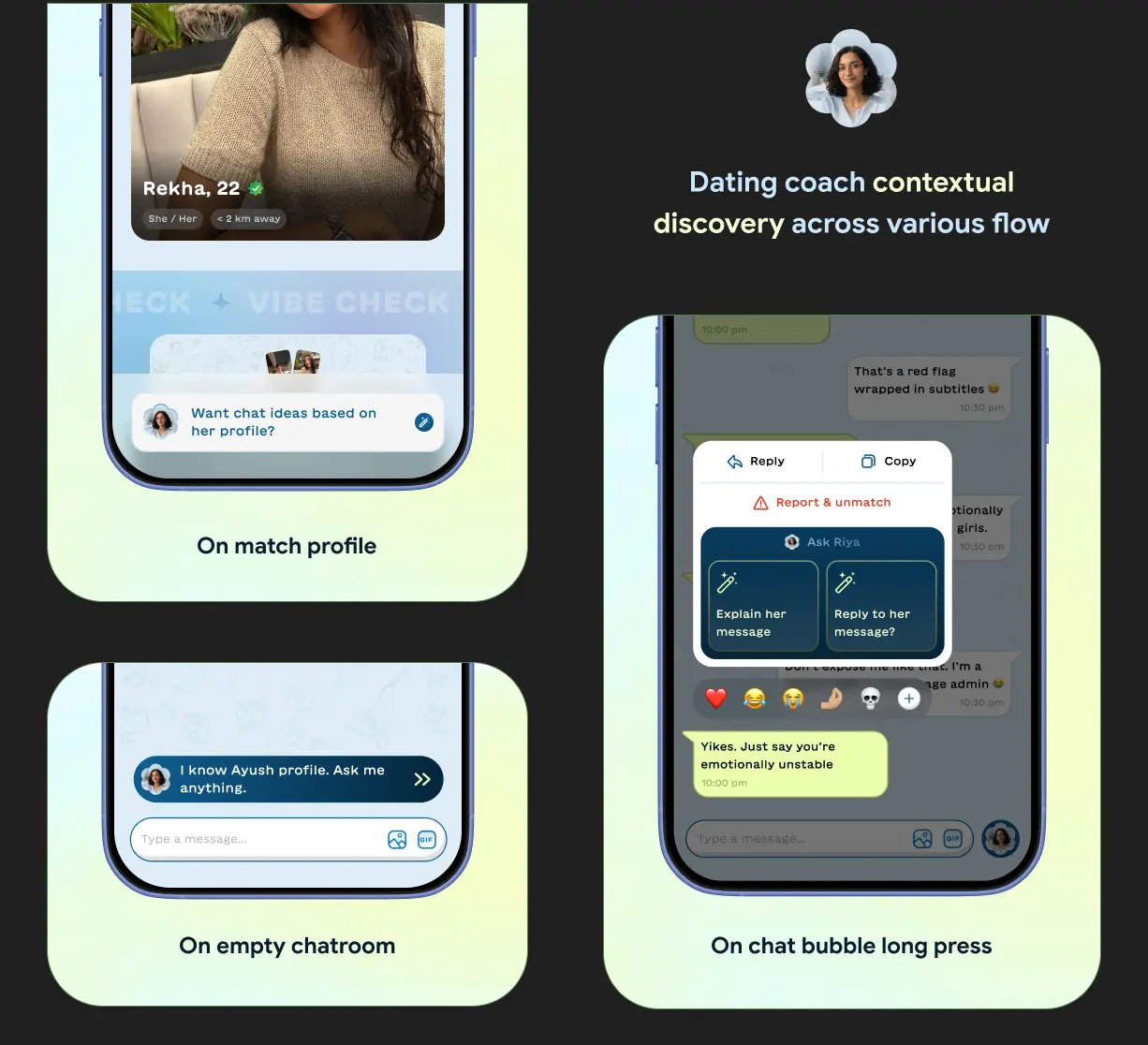
As a result Dormant chatrooms fell from around ~30% to 12%.
The lesson: Helping someone say something beats saying it for them.
The accidental winner - People Finder
Where it came from. Not a roadmap. Not a brainstorm. Customer support. The same request kept landing in the queue: I want to match with someone from my college. From my community. Someone tall. Users were trying to search the app, and we hadn't given them a search box.
What we built. Natural-language search for people. Type what you're after, and the AI surfaces profiles that fit - with hard guardrails bolted on: no searching by name, NSFW queries blocked, and every result still filtered through your existing match preferences, so nobody could sweet-talk the prompt into showing them people outside their settings.
Adoption climbed but we hit a problem: 90% of users who got zero results never searched again. One empty screen and they were gone. We replaced zero results with next-best ones. Search for someone from a specific college, we'd show people from nearby colleges instead. No dead ends. We did this across multiple query types and drop-off from failed searches fell. Over time, People Finder grew into 10-15% of daily revenue. The AI was a search engine, not a decision-maker. The user stayed in control.
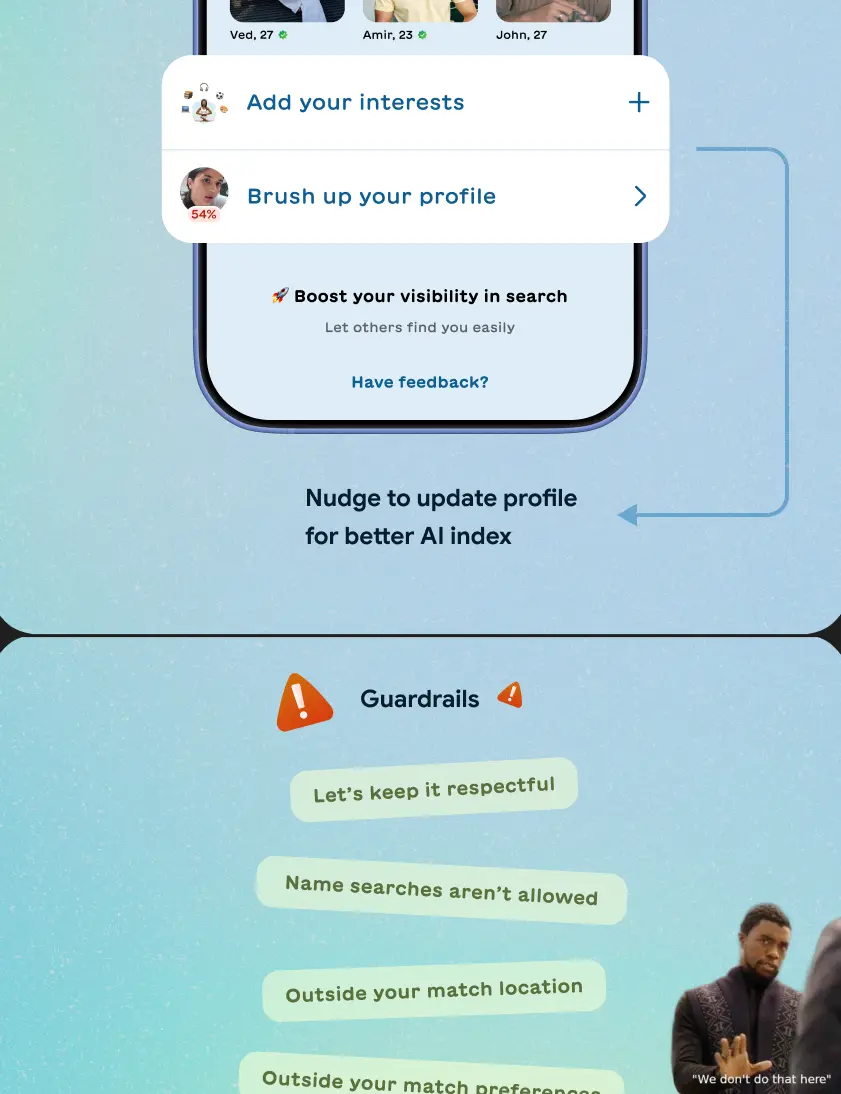
The lesson: Give people a tool, not a judgment. What separated our failed AI features from our most profitable one wasn't the tech. It was who was in control.
Matchmaker - Bet that didn't pay off
Riya Matchmaker. The most ambitious thing we built. Skip swiping entirely, just tell an AI what you want in a partner, and Riya finds the profiles. On a whiteboard it looked spectacular.
We launched voice-first. You'd call Riya and describe your ideal match out loud. 90% drop-off inside the first minute. Talking to a bot about your romantic preferences turns out to be deeply, physically awkward. The intimacy of voice with none of the trust that earns it.
We added chat. Drop-off improved to around 15%, still too high. Riya consumed more tokens than any other AI feature we built. Monetising it was hard to justify, and the company shut down before we could make the final call.
People weren't ready to tell an AI what they wanted in a partner, or about themselves. Most didn't know how to answer either question. When Riya asked, the honest answer for most users was "I don't know," and an AI that needs a clear brief can't do much with that. Users also don't want the choice taken away. When a bot hands you a shortlist, it quietly steals the part that makes a match feel earned.
The lesson: AI stepped in front of the user instead of standing behind them. Convenience isn't always the value people want. Sometimes the effort is the point.


During an intense building phase